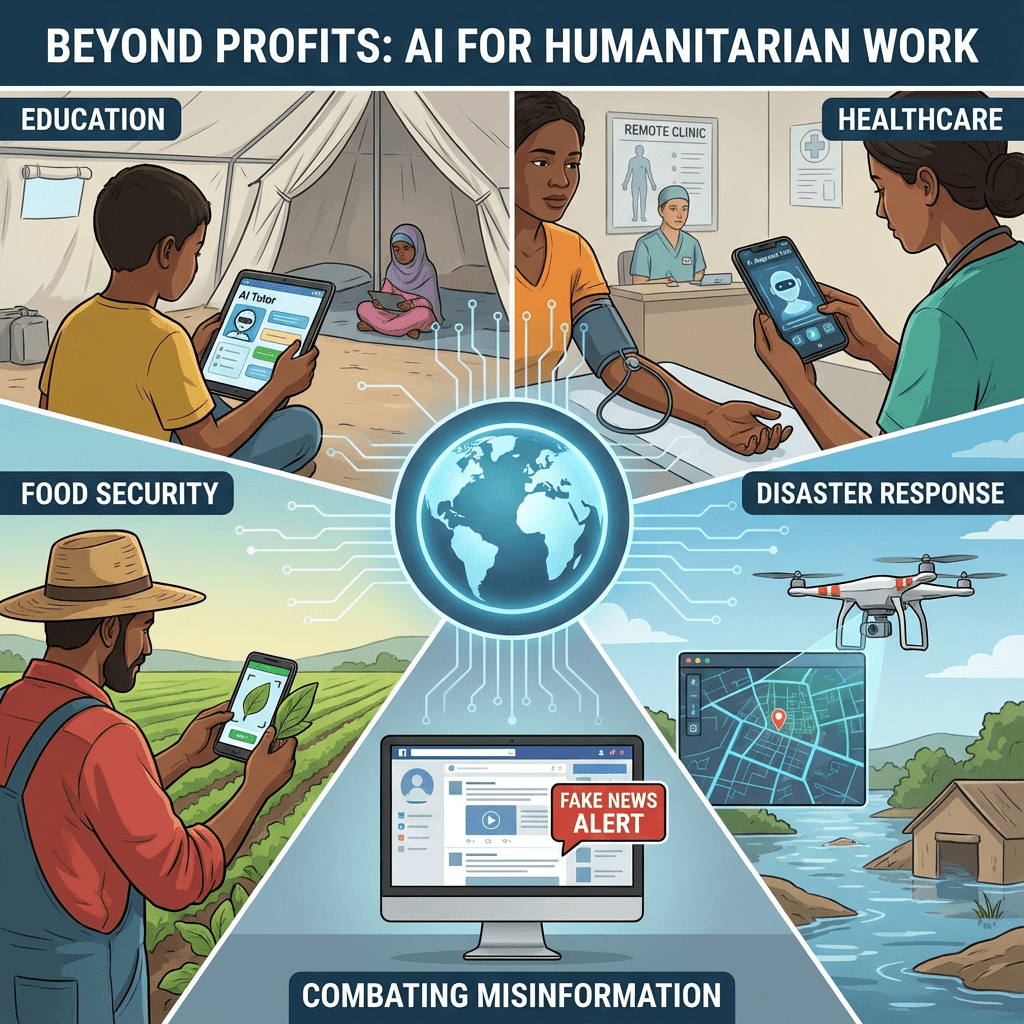
In a remote health clinic in a conflict zone, a nurse sits across from a mother holding a feverish child. The child has a cough, difficulty breathing, and a rash on his chest. Is it malaria? Pneumonia? Measles? The nearest hospital is three days away by foot. The nurse has basic training, limited diagnostic tools, and no specialist to consult. The decision she makes in the next few minutes will determine whether this child lives or dies.
This scene plays out thousands of times every day across the humanitarian world. Health workers in remote areas, refugee camps, and disaster zones are expected to make life-and-death diagnostic and treatment decisions with limited training, incomplete information, and overwhelming caseloads. They are doing heroic work with inadequate tools. Many of them carry the weight of diagnostic uncertainty for the rest of their lives.
What if you could give every frontline health worker access to a world-class diagnostic advisor? What if they could describe a patient’s symptoms, and an AI system could instantly suggest the most likely diagnoses, recommend tests, and guide treatment protocols? What if they could check for dangerous drug interactions before prescribing? What if they could identify high-risk pregnancies before complications arise?
This is not science fiction. This is what a large language model (LLM) can do for your health workers today. This masterclass will teach you how to use AI as a decision support system for frontline medical teams. We will provide a five-phase workflow with practical, copy-and-paste prompts to help your health workers make better decisions, faster, and with more confidence. The goal is clear: save more lives with the resources you have.
The Five-Phase AI Workflow for Health Decision Support
This workflow provides a structured framework for using AI to support every stage of clinical decision-making, from initial assessment to follow-up care.
| Phase | Focus | Key AI-Powered Outcome |
| Phase 1 | Symptom-to-Diagnosis Guidance | Analyze symptoms and suggest likely diagnoses with supporting rationale. |
| Phase 2 | Triage & Urgency Assessment | Prioritize patients based on severity and urgency of care needed. |
| Phase 3 | Treatment Protocol Support | Recommend evidence-based treatment protocols for confirmed diagnoses. |
| Phase 4 | Drug Interaction & Safety Checking | Flag dangerous medication combinations and contraindications. |
| Phase 5 | High-Risk Identification & Referral | Identify patients who need specialist care or urgent referral. |
Let’s explore how to execute each phase with practical prompts.
Phase 1: AI as Your Diagnostic Advisor
A health worker describes a patient’s symptoms. AI analyzes them and suggests the most likely diagnoses, ranked by probability, along with the clinical reasoning. This is not a replacement for clinical judgment; it is a thinking partner that helps the health worker consider possibilities they might otherwise miss.
The Prompt:
Act as a clinical decision support system for a health worker in a remote clinic with limited diagnostic capabilities. A patient presents with the following symptoms:Patient Information:
•Age: [Age]
•Sex: [Male/Female]
•Location: [Geographic region, e.g., “rural area with high malaria prevalence”]
•Vaccination status: [Vaccinated/Unvaccinated/Unknown]
Chief Complaint & Symptoms:
•[Symptom 1, e.g., “Fever for 5 days”]
•[Symptom 2, e.g., “Severe headache”]
•[Symptom 3, e.g., “Body aches”]
•[Symptom 4, e.g., “Vomiting”]
Vital Signs (if available):
•Temperature: [e.g., “39.5°C”]
•Heart Rate: [e.g., “110 beats per minute”]
•Respiratory Rate: [e.g., “28 breaths per minute”]
Task:
1.Based on these symptoms, provide a ranked list of the top 5 most likely diagnoses.
2.For each diagnosis, explain the clinical reasoning in 2-3 sentences.
3.For each diagnosis, list the key diagnostic tests that would confirm it (even if not available at the clinic, this helps the health worker understand what to look for).
4.Highlight any red flags that suggest this patient needs urgent referral.
5.Present this in a clear table format.
Phase 2: AI as Your Triage Officer
During a crisis or in an overwhelmed clinic, triage is critical. AI can help you quickly assess which patients need immediate care, which can wait, and which can be managed at home. This ensures resources are directed to those in greatest need.
The Prompt:
Act as a triage specialist for a humanitarian health clinic. I am providing you with brief descriptions of [Number] patients who have arrived at the clinic today. The clinic has limited resources: one doctor, two nurses, and basic supplies.Patient List:
•Patient 1: [Brief description, e.g., “6-year-old with severe difficulty breathing, stridor, drooling”]
•Patient 2: [Brief description, e.g., “45-year-old with chest pain and shortness of breath”]
•Patient 3: [Brief description, e.g., “3-year-old with mild cough and runny nose”]
•Patient 4: [Brief description, e.g., “Pregnant woman with severe abdominal pain and vaginal bleeding”]
•Patient 5: [Brief description, e.g., “Adult with minor cut on hand, needs wound cleaning”]
Task:
1.Assign each patient to one of four triage categories: IMMEDIATE (Life-threatening, needs care now), URGENT (Serious, needs care within 1 hour), DELAYED (Stable, can wait 2-4 hours), or MINOR (Non-urgent, can be managed at home or sent to outpatient clinic).
2.For each patient, provide a brief justification for your triage category.
3.Suggest the order in which patients should be seen.
4.For DELAYED and MINOR patients, suggest simple interventions the nurse can do while waiting for the doctor.
5.Present this as a triage board that the clinic can print and use.
Phase 3: AI as Your Treatment Protocol Guide
Once a diagnosis is suspected or confirmed, the health worker needs to know what to do. AI can provide evidence-based treatment protocols tailored to the resources available in a remote clinic, including dosing, duration, and monitoring.
The Prompt:
Act as a clinical protocol advisor for a remote health clinic. The clinic has confirmed a diagnosis of [Diagnosis, e.g., “uncomplicated malaria”] in a [Patient type, e.g., “5-year-old child”].Available Resources:
•Medications available: [List, e.g., “artemether, quinine, paracetamol, ibuprofen”]
•Diagnostic tools: [List, e.g., “rapid diagnostic test, blood smear microscopy”]
•Monitoring capability: [e.g., “basic vital signs, no lab tests”]
Task:
1.Provide a step-by-step treatment protocol for this diagnosis, including:
•Recommended first-line medication and dosage (weight-based if applicable)
•Duration of treatment
•Monitoring parameters (what to watch for during treatment)
•When to escalate or change treatment
2.Provide a second-line option if the first-line medication is not available or the patient does not respond.
3.List any supportive care measures (e.g., fluids, nutrition, rest).
4.Specify clear criteria for when this patient should be referred to a higher-level facility.
5.Present this as a simple, one-page protocol that a health worker can follow.
Phase 4: AI as Your Drug Safety Checker
Polypharmacy (using multiple medications) is common, especially in patients with chronic conditions. Drug interactions can be dangerous or even fatal. This prompt helps health workers check for dangerous combinations before prescribing.
The Prompt:
Act as a pharmacist specializing in drug interactions. A health worker is about to prescribe the following medications to a patient:Patient Information:
•Age: [Age]
•Pregnancy status: [Pregnant/Not pregnant/Unknown]
•Kidney function: [Normal/Impaired/Unknown]
•Liver function: [Normal/Impaired/Unknown]
Current Medications:
•[Medication 1, e.g., “Artemether 80mg IM daily”]
•[Medication 2, e.g., “Quinine 600mg IV every 8 hours”]
•[Medication 3, e.g., “Paracetamol 500mg every 6 hours”]
•[Medication 4, e.g., “Amoxicillin 500mg every 8 hours”]
Task:
1.Check for any dangerous drug-drug interactions.
2.Check for any contraindications based on the patient’s age, pregnancy status, or organ function.
3.For any interactions or contraindications found, explain the risk in simple language.
4.Suggest safer alternatives if available.
5.Provide a clear recommendation: SAFE TO PRESCRIBE, USE WITH CAUTION (monitor closely), or DO NOT PRESCRIBE (dangerous).
6.Present this as a simple safety checklist.
Phase 5: AI as Your High-Risk Identifier
Some patients need specialist care or urgent referral. AI can help you identify these high-risk cases before complications arise, potentially saving lives through timely referral.
The Prompt:
Act as a clinical risk assessor for a humanitarian health program. I am providing you with clinical information on [Number] patients. I need you to identify which patients are at high risk and need urgent referral or specialist consultation.Patient Summaries:
•Patient 1: [Clinical summary, e.g., “Pregnant woman, 28 weeks gestation, blood pressure 160/110, proteinuria +3”]
•Patient 2: [Clinical summary, e.g., “Child, 18 months old, severe acute malnutrition, diarrhea, fever”]
•Patient 3: [Clinical summary, e.g., “Adult, diabetic, blood glucose 450 mg/dL, fruity-smelling breath”]
•Patient 4: [Clinical summary, e.g., “Child, 3 years old, cough for 2 weeks, weight loss, TB contact”]
Task:
1.For each patient, identify the key risk factors that suggest they need specialist care or urgent referral.
2.Classify each patient’s risk level: IMMEDIATE REFERRAL (life-threatening), URGENT REFERRAL (within 24 hours), or ROUTINE REFERRAL (within 1 week).
3.For each patient, specify what type of specialist or facility they should be referred to.
4.Suggest what monitoring or supportive care should be provided while awaiting referral.
5.Present this as a referral prioritization list that the clinic can use.
AI as Your Trusted Advisor, Not Your Replacement
Let me be absolutely clear: AI is not a replacement for clinical judgment. A health worker’s experience, intuition, and knowledge of their community are irreplaceable. What AI provides is a thinking partner—a way to access medical knowledge instantly, to catch things you might miss, and to give you the confidence to make better decisions.
The prompts in this masterclass are designed to support, not replace, human decision-making. They should always be used in conjunction with clinical judgment, local protocols, and consultation with more experienced colleagues when available.
By using AI as a decision support tool, you are not diminishing your role as a health worker; you are amplifying it. You are bringing the knowledge of the world’s best medical minds to your clinic, so you can provide better care with the resources you have.
Your patients deserve the best care possible. Use these tools to give it to them.
Manager's Recommendation: Build Custom AI Agents
If you want to turn your data into a custom AI agent for your business without writing code, CustomGPT.ai is the most powerful solution available today.
Build Your AI Agent →Ready to Master AI in 28 Days?
Take the next step in your professional journey with our structured, step-by-step roadmap designed specifically for non-technical founders and professionals.
Start the 28-Day Plan →Recommended hosting (what I use)
If you’re building a WordPress site, Hostinger is a solid budget-friendly option.
Disclosure: This is a referral link (supports the site at no extra cost to you).